
Themes /
Cash Barometer
The benefits of cash and voucher assistance (CVA) programming has been demonstrated many times over. But we believe user feedback can help inform a more effective roll-out of cash-based assistance.
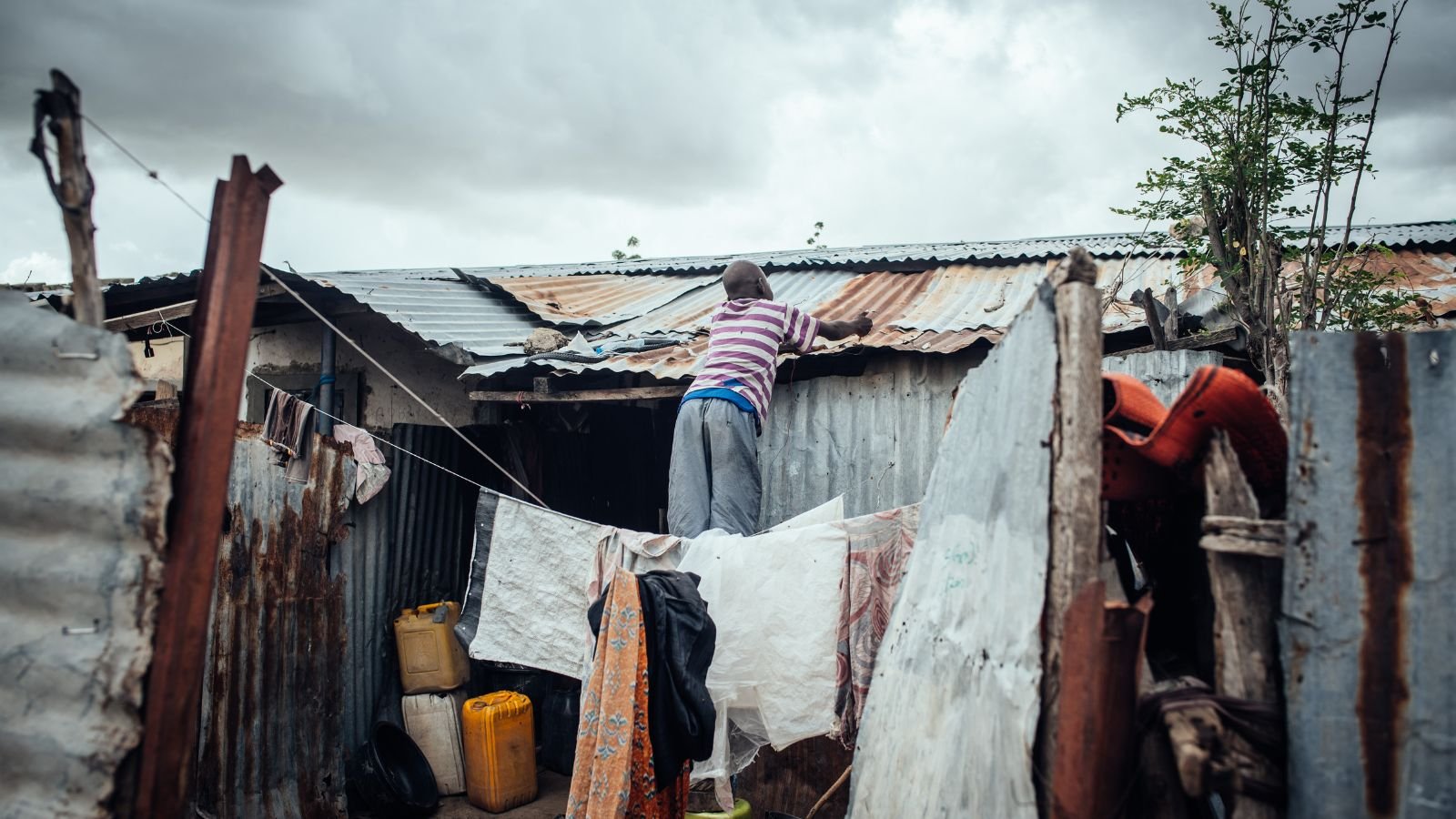
A man repairs the roof of his home in an IDP Camp in Borno, Nigeria. Photo: KC Nwakalor/GTS
How does the humanitarian “cash revolution” present itself to the intended beneficiaries? What concerns do affected people have? And how can their perspectives help inform a more effective roll-out of cash-based assistance? These are just some of the questions we asked ourselves at Ground Truth Solutions.
“We need humanitarian to provide ways to learn how to start businesses or to go give us capital so we can take care of our needs ourselves.” - 51-year-old man in Borno, Nigeria.
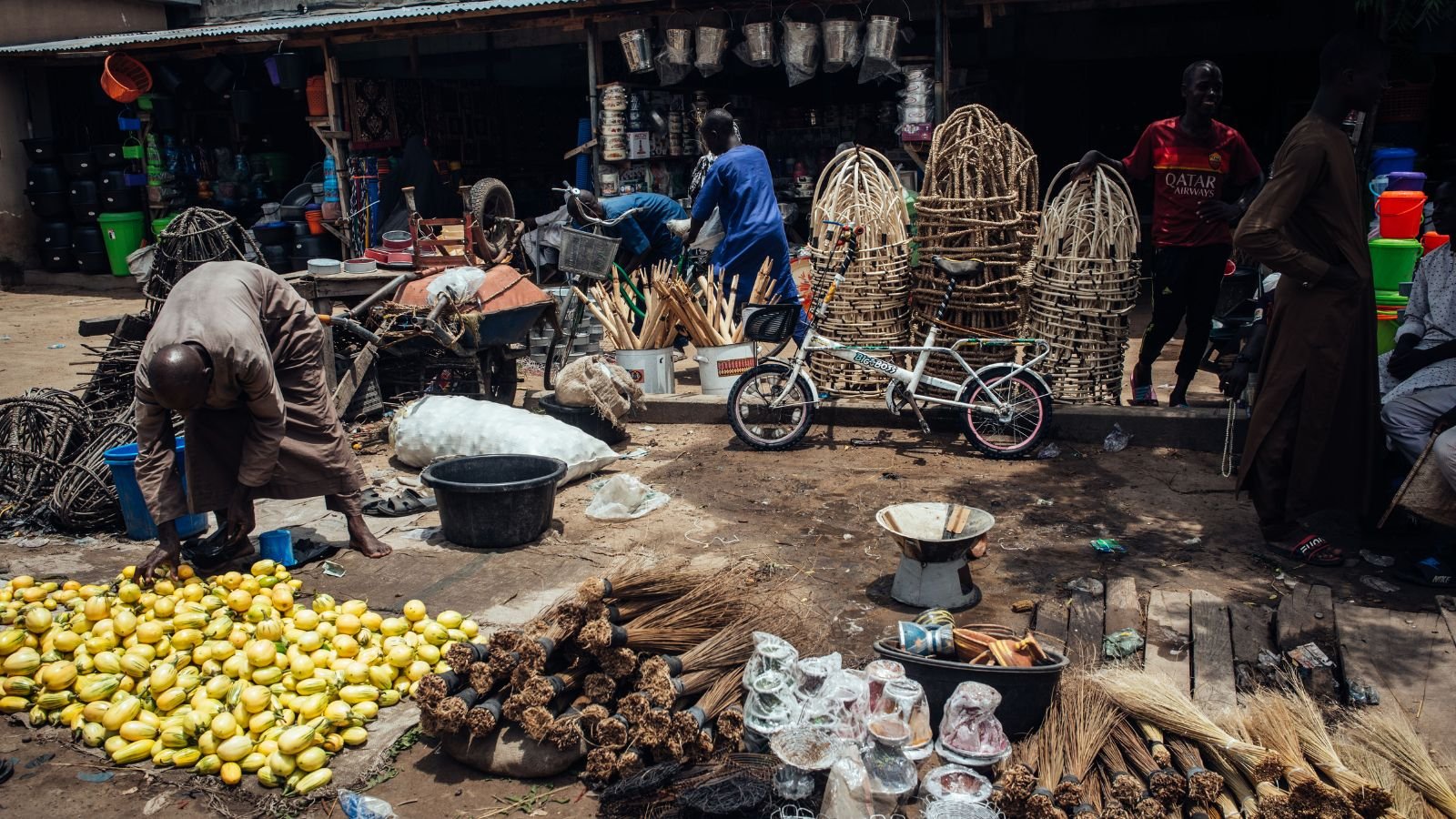
A market place in an IDP camp in Borno, Nigeria where Ground Truth Solutions is tracking attitudes, perceptions, and preferences of communities in relation to the cash and voucher assistance (CVA). Photo: KC Nwakalor/GTS
What we are doing
The Cash Barometer is an independent accountability mechanism that combines standardised face-to-face surveys with user-centred approaches to allow cash recipients to provide feedback on cash and voucher assistance and participate in decision making.
We have collected the perspectives of thousands of CVA recipients through face-to-face surveys across Nigeria, Somalia, and the Central African Republic over several years. By facilitating discussions with smaller focus groups and through in-depth interviews, we have uncovered more details about the barriers and challenges people face. Finally, we close the loop by feeding back the recommendations and views we collect to humanitarian organisations, challenge and support them to adapt programming based on recipients’ perceptions, and empower communities by speaking to them about their data.
Ground Truth Solutions also offers training for humanitarian staff working on cash and voucher programmes, which we call “Accountability in Action”. In a series of workshops in 2022, we worked with agencies on how to use feedback from aid recipients to inform project design, implementation, and monitoring.
We launched the Cash Barometer with support from the German Federal Foreign Office and the Norwegian Ministry of Foreign Affairs. Since then, we have added further projects on cash and voucher assistance in Ukraine, funded by the Disasters Emergency Committee through the Collaborative Cash Delivery Network.
Contact

Hannah Miles
Research Manager
Our Cash Barometer projects

Cash-based programming has been a key component of the humanitarian response in Ukraine since the escalation of the conflict into a full-scale war in February 2022. In 2022 alone, 5.6 million people were reached with multi-purpose cash assistance (MPCA), making it the largest humanitarian cash assistance programme in history.

The Cash Barometer launched in CAR in 2020 in the context of the COVID-19 pandemic, where we sought to capture the voices of market traders and CVA recipients in the context of the developing crisis. Since then, CVA significantly scaled up in CAR, making it even more critical than ever to ensure the voices of CVA recipients are heard.

Ground Truth Solutions has been tracking the experiences of aid recipients in Somalia and Somaliland since 2017. In this time, cash and voucher recipients have consistently requested more involvement and consultation from aid actors than they receive.

In late 2019, we launched the Cash Barometer in Nigeria with a survey of CVA recipients in Borno State. Following the COVID-19 pandemic, we adapted our approach to explore how CVA recipients, humanitarians, and financial service providers perceived the economic impact of the pandemic.

In collaboration with the World Food Programme (WFP), Ground Truth Solutions explored the lived experiences or user journeys of women receiving mobile money in Somalia.

In collaboration with CAMEALEON and WFP, Ground Truth Solutions explored the lived experiences or user journeys of Syrians receiving multi-purpose cash (MPC) assistance from the World Food Programme (WFP) in Lebanon.

Covid-19 has sparked an economic crisis that will disproportionately affect the most vulnerable members of society, particularly in humanitarian contexts. The Cash Barometer project explores its economic impact, helping humanitarians to better understand its various effects, as well as to what extent recipients’ perspectives inform cash and voucher assistance (CVA) responses, on two levels: global and in-country.

Humanitarian cash programming comes with inherent risks. With its increased use, organisations are rightly becoming more attuned to barriers and challenges that affected populations face. This includes abuses of power by financial service providers as well as the ability to voice complaints and share feedback.

Billions of dollars in humanitarian cash and voucher assistance (CVA) programmes are delivered annually to populations affected by conflict and natural disasters to enable them to meet their basic needs.

Humanitarian agencies today increasingly deliver cash to affected people, using a growing number of mechanisms to transfer money. From digital payment systems to more traditional methods of delivering funds, there is still much to be learned about how well these systems can meet recipients’ needs and satisfy their preferences.
Latest Cash Barometer publications

Overcoming power imbalances: Community recommendations for breaking the cycle

Espèces, coupons… ? Ou simplement une meilleure mise en oeuvre ? Ce que veulent les personnes recevant l’aide à Kaga-Bandoro

Cash or vouchers? Or just good implementation? What aid recipients in Kaga-Bandoro want

"Men have the power to say everything, women don't." Women’s perceptions of cash and voucher assistance in Maiduguri’s outskirts

With the stakes so high, is Cash and Voucher Assistance the lifeline it’s meant to be?

Face à des enjeux aussi cruciaux, les transferts monétaires font-ils le poids?

People need choices for an uncertain future

Rights, information, and predictability: Keys to navigate a complex crisis

User journey personas of women receiving mobile money in Somalia

Exploring the user journeys of women receiving mobile money in Somalia

Community reflections: The cumulative impact of keeping people informed

Expériences des bénéficiaires d’assistance monétaire en République Centrafricaine

Experiences of cash and voucher assistance in the Central African Republic
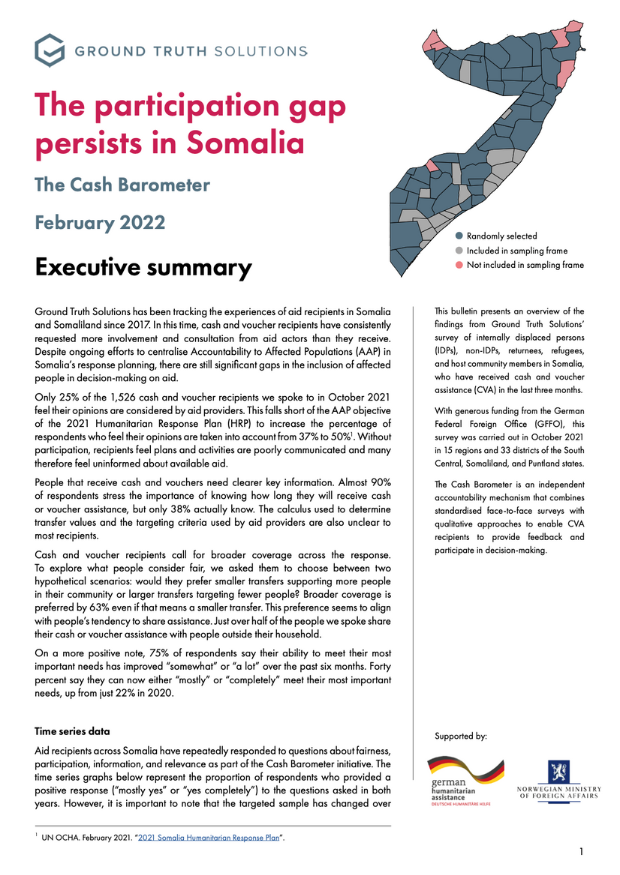
The participation gap persists in Somalia

Respected but uninformed: Feedback from cash and voucher recipients in Nigeria’s BAY states

The key to fairness is inclusion: Understanding perceptions of fairness and aid modality preferences in BAY States

User journeys of Syrian refugees receiving multi-purpose cash from WFP in Lebanon

Perception survey of aid recipients in Somalia

Mobile money enabled cash assistance: User journeys in Burundi

Perceptions of Cash and Voucher Recipients in BAY States

Témoignages clés de commerçants et bénéficiaires d’assistance monétaire

Perceptions of cash and voucher recipients and market traders on received aid and COVID-19

Analysis: Cash Barometer Central African Republic - August 2020

Cash Barometer Nigeria bulletin: Borno State February 2020

Mitigating the risks of abuse of power in cash assistance

Improving user journeys for humanitarian cash transfers